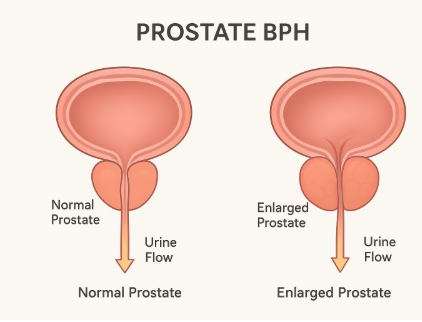
Prostate BPH stands for Benign Prostatic Hyperplasia — a non-cancerous enlargement of the prostate gland that commonly occurs in older men.
Here’s a breakdown:
🧠 Definition
Benign = not cancerous
Prostatic = related to the prostate gland
Hyperplasia = increase in the number of cells
So, BPH means the prostate grows larger because the number of its cells increases.
📍 Why It Happens
As men age, changes in hormone levels (especially testosterone and dihydrotestosterone, or DHT) stimulate prostate growth.
This usually begins around age 40 and progresses slowly over time.
⚙️ What the Prostate Does
The prostate gland sits just below the bladder and surrounds the urethra (the tube that carries urine out of the body).
When it enlarges, it can press on the urethra, causing urinary problems.
🚽 Common Symptoms
Weak or slow urine stream
Difficulty starting urination
Dribbling after urination
Frequent urination, especially at night (nocturia)
Urgency to urinate
Feeling like the bladder isn’t fully empty
🧪 Diagnosis
Digital rectal exam (DRE)
PSA blood test (prostate-specific antigen)
Urine flow test
Ultrasound or post-void residual volume test
💊 Treatment Options
Depends on symptom severity:
Lifestyle changes (reduce caffeine/alcohol, avoid late-night fluids)
Medications
Alpha-blockers (e.g., tamsulosin)
5-alpha reductase inhibitors (e.g., finasteride)
Minimally invasive procedures (e.g., UroLift, Rezūm)
Surgery (e.g., TURP — transurethral resection of the prostate)
⚠️ Important Note
BPH does not cause prostate cancer, but the two can occur together, so regular check-ups are important.