
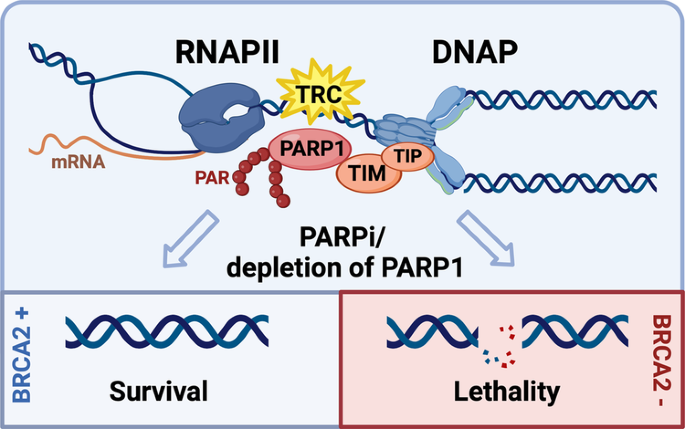
One of the most consequential developments in prostate cancer research this year has nothing to do with a new drug class — it’s about when an existing one gets used, and who qualifies for it. PARP inhibitors, a family of drugs originally developed for BRCA-mutated breast and ovarian cancers, are being pushed earlier into prostate cancer treatment, backed by trial results strong enough to reshape genetic testing guidelines.
What PARP inhibitors actually do
PARP is an enzyme cells rely on to repair small breaks in their DNA before those breaks become more dangerous. Cancer cells that already have faulty DNA-repair machinery — most notably through mutations in homologous recombination repair (HRR) genes such as BRCA1, BRCA2, ATM, and others — depend heavily on PARP to survive. PARP inhibitors block this backup repair pathway and, in some cases, physically trap the PARP enzyme onto damaged DNA so it can’t be released. For cells that already have one broken repair system, losing the second is often lethal. Healthy cells, which typically retain normal DNA repair, are far less affected.
This is precision medicine in a fairly literal sense: the drug’s effectiveness depends on a tumor’s genetic makeup, not just its stage or location.
The trial that moved the needle: TALAPRO-3
The headline result of 2026 came from TALAPRO-3, a Phase III trial presented at the ASCO Annual Meeting and published in the New England Journal of Medicine. The study enrolled men with metastatic hormone-sensitive prostate cancer carrying HRR gene alterations — not limited to BRCA1/2, but spanning a broader panel of repair genes. Roughly a third of participants had BRCA1/2 mutations; the rest had other HRR alterations.
Patients were randomized to standard hormone therapy (ADT plus enzalutamide) with or without the PARP inhibitor talazoparib. The results were striking: a 52% reduction in the risk of cancer progression or death in the talazoparib group, with the median time to progression not yet reached at three years of follow-up, compared with under four years in the control group. At three years, 77% of men on talazoparib had not progressed, versus 56% on standard therapy alone.
Notably, the benefit wasn’t confined to the classic BRCA1/2 population — men with other HRR gene alterations also benefited, which is part of why the trial is prompting a broader rethink of who should be tested and treated.
Guidelines are catching up
Genetic testing has historically lagged behind the science in prostate cancer, with many men never tested for inherited or tumor-specific mutations that could change their treatment options. That is now shifting. The 2026 Advanced Prostate Cancer Guideline from the American Urological Association and the Society of Urologic Oncology now formally recommends germline genetic testing for all patients with advanced prostate cancer, and somatic (tumor) testing for everyone with metastatic disease.
This matters because roughly 1 in 11 patients with advanced prostate cancer carry inherited mutations linked to more aggressive disease — mutations that would go undetected without testing, and that increasingly determine eligibility for PARP inhibitor therapy.
Nuance matters: not a drug for everyone
Despite the encouraging data, researchers presenting at both ASCO and the EAU 2026 meeting were careful to note that PARP inhibitors are not a broad, one-size-fits-all addition to prostate cancer treatment. In hormone-sensitive disease, the clearest benefit has been demonstrated in patients with BRCA2 mutations specifically, and experts have cautioned against applying PARP inhibitors indiscriminately to unselected patients without HRR alterations. The message from specialists is consistent: the mutation profile — not just the stage of disease — should guide the decision.
This is also why the trial results are being paired so closely with the new testing recommendations. A drug this targeted is only as useful as the diagnostic pathway that identifies who should receive it.
What this means going forward
The direction of travel is clear: genetic testing is becoming a routine, early step in prostate cancer care rather than a late-stage afterthought reserved for men who’ve exhausted other options. For patients newly diagnosed with advanced or metastatic prostate cancer, this research suggests it’s reasonable to ask your care team directly:
- Has germline (inherited) genetic testing been done, and should it be?
- Has the tumor itself been tested for HRR gene alterations?
- If a relevant mutation is found, is a PARP inhibitor combination appropriate now, rather than later in treatment?
As with all emerging research, these findings describe a fast-moving area of oncology, and treatment decisions should be individualized in conversation with a physician familiar with the latest data.
This article summarizes research presented at the 2026 ASCO and EAU annual meetings and published in the New England Journal of Medicine. It is intended for general information and is not medical advice.